
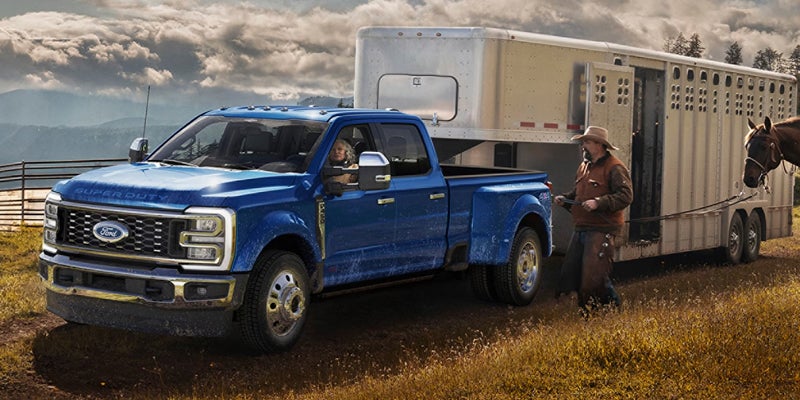
The 2027 Ford F-250 Super Duty can tow up to 23,000 pounds with a gooseneck trailer, 22,100 pounds with a fifth-wheel trailer, or 22,000 pounds with a conventional trailer when properly equipped. However, the towing capacity of an individual F-250 depends on its engine, axle ratio, cab configuration, drivetrain, towing equipment, and available payload. For truck shoppers around Enid, Oklahoma, understanding these differences is especially important when transporting farm equipment, livestock trailers, construction machinery, and heavy utility trailers. Knowing the weight of your loaded trailer and the type of hitch it requires can help you choose an F-250 configured for the work you need to accomplish.
Shop New Ford F-250 Trucks Schedule an F-250 Test Drive
2027 Ford F-250 Towing Capacity by Trailer Type
The maximum towing capacity of the 2027 Ford F-250 varies depending on how the trailer connects to the truck and which equipment is installed.
Conventional trailers connect to a hitch behind the rear bumper, while gooseneck and fifth-wheel trailers connect to hitch equipment mounted in the truck bed.
| Towing Configuration | Maximum Available Capacity | Common Applications |
|---|---|---|
| Conventional Towing | Up to 22,000 lbs. | Utility trailers, equipment trailers, certain livestock trailers, and recreational trailers |
| Gooseneck Towing | Up to 23,000 lbs. | Livestock trailers, agricultural trailers, and heavy equipment haulers |
| Fifth-Wheel Towing | Up to 22,100 lbs. | Compatible fifth-wheel campers and commercial trailers |
Maximum available 2027 F-250 ratings apply only to specific properly equipped configurations. These figures are not interchangeable and do not establish the towing capacity of every F-250. Always verify the individual truck's ratings, required packages, trailer equipment, passengers, and cargo weight.
For drivers working around Enid, Fairview, and Kingfisher, the distinction matters because the trailer's hitch type and loaded weight help determine which truck configuration is appropriate.
A gooseneck livestock trailer, for example, creates different loading demands than a conventional utility trailer carrying landscaping equipment.
Conventional Towing: Utility Trailers, Equipment, and Everyday Hauling
The 2027 Ford F-250 can tow up to 22,000 pounds using a conventional trailer hitch when properly equipped.
Conventional towing uses a trailer connection behind the truck's rear bumper. This arrangement is common for utility trailers, certain equipment haulers, smaller livestock trailers, and recreational trailers.
For a construction contractor working around Enid, a conventional equipment trailer may be useful for transporting compact machinery, building materials, or work tools between jobs.
What Determines Conventional Towing Capacity?
The maximum weight a specific F-250 can tow depends on more than the truck's engine.
Important factors include:
- Engine and transmission configuration.
- Rear axle ratio.
- Cab and bed configuration.
- Two-wheel-drive or four-wheel-drive equipment.
- Gross Combined Weight Rating (GCWR).
- Required towing and axle packages.
- Receiver, hitch ball, and related equipment ratings.
- Passenger, cargo, and accessory weight.
Ford's maximum conventional towing rating requires a specific configuration and equipment, including the F-250 High-Capacity Axle Upgrade Package for certain higher ratings.
For example, a four-wheel-drive Crew Cab F-250 equipped for farm or construction use may have a different towing limit from the configuration used to establish Ford's maximum advertised rating.
Before purchasing, compare the actual truck's specifications with the total loaded weight of the trailer you intend to use.
Gooseneck Towing: A Practical Option for Agricultural Work
The 2027 Ford F-250 offers a maximum available gooseneck towing capacity of 23,000 pounds.
Gooseneck trailers connect to a hitch ball mounted in the truck bed, generally over or near the rear axle.
This arrangement is frequently used for livestock trailers, agricultural equipment trailers, and other heavy-duty hauling applications.
For farmers and ranchers around Fairview, Alva, and Northwest Oklahoma, a properly equipped F-250 may provide the capability needed to transport certain livestock or machinery loads.
Why Use a Gooseneck Trailer?
Gooseneck trailers distribute part of their weight through a connection in the truck bed rather than through a receiver behind the rear bumper.
This arrangement can offer handling and weight-distribution advantages for compatible heavy-duty trailer applications.
However, the hitch location does not eliminate the need to account for the load placed on the truck.
The downward force from the trailer's gooseneck connection counts against the truck's available payload and rear axle capacity.
A trailer can be within the F-250's published towing rating while still exceeding the specific truck's payload or axle limits.
Which F-250 Reaches the 23,000-Pound Rating?
Ford identifies the maximum 23,000-pound gooseneck rating with a properly equipped 2027 F-250 XL Regular Cab 4x2 featuring the available 6.7L High-Output Power Stroke diesel engine and required towing equipment.
Other F-250 configurations may have lower limits.
Drivers considering a Crew Cab, four-wheel drive, off-road equipment, or additional accessories should verify the corresponding rating rather than assuming the maximum applies.
Fifth-Wheel Towing: Larger Recreational and Commercial Trailers
The 2027 Ford F-250 offers a maximum available fifth-wheel towing capacity of 22,100 pounds when properly equipped.
Fifth-wheel trailers connect to a specialized hitch mounted inside the truck bed.
This towing arrangement is common for large recreational campers and certain commercial trailers.
For families around Enid who travel with a fifth-wheel camper, an F-250 may offer substantial towing capability, depending on the trailer's actual loaded weight and the truck's configuration.
However, the weight placed on the fifth-wheel hitch can consume a significant portion of the truck's available payload.
Before purchasing a truck for a particular fifth-wheel trailer, compare the trailer's loaded weight and pin weight with the truck's towing capacity, payload rating, rear axle rating, and hitch limits.
Truck-bed clearance and turning clearance must also be evaluated, particularly with certain shorter-bed configurations.
2027 Ford F-250 Engine Options for Heavy-Duty Towing
The 2027 Ford F-250 offers two primary engine choices: a standard 7.3L gasoline V8 and an available 6.7L High-Output Power Stroke turbo-diesel V8.
Both are designed for heavy-duty truck applications, but the right engine depends on the type and frequency of work involved.
7.3L V8 Gasoline Engine
The 7.3L V8 gasoline engine is standard on the 2027 F-250.
This engine provides substantial power for work trucks used to transport equipment, carry materials, and tow compatible trailers.
For a contractor working around Kingfisher who uses a truck for daily transportation and occasional equipment hauling, the gasoline engine may provide the capability needed without requiring a diesel powertrain.
Drivers should consider the truck's actual towing and payload ratings, fuel requirements, operating expenses, and expected annual mileage.
6.7L High-Output Power Stroke Turbo-Diesel
The available 6.7L High-Output Power Stroke turbo-diesel is designed for demanding heavy-duty applications.
Its substantial torque output can be especially useful when pulling heavy trailers, transporting equipment, or maintaining momentum under load.
For farmers and contractors who tow frequently throughout Northwest Oklahoma, the diesel may be worth considering.
Diesel ownership also introduces additional considerations, including diesel exhaust fluid, fuel system maintenance, emissions-related components, and other manufacturer-recommended services.
Choosing an engine should involve more than comparing maximum towing figures. The frequency of towing, total loaded weight, annual mileage, purchase cost, and long-term maintenance expectations are all relevant.
Can the 2027 Ford F-250 Tow a Livestock Trailer?
Yes. A properly equipped 2027 Ford F-250 can tow many compatible livestock trailers, provided the total loaded trailer weight and hitch requirements remain within the truck's ratings.
Livestock trailers may use conventional or gooseneck hitch arrangements depending on their size and design.
For ranchers transporting cattle or horses around Enid, Fairview, or Alva, it is important to consider more than the trailer's empty weight.
The loaded trailer weight must account for:
- The trailer itself.
- The animals being transported.
- Feed, water, and other supplies.
- Equipment and accessories stored inside the trailer.
- Any additional cargo.
Livestock can shift their weight while the trailer is moving, making proper loading, appropriate trailer equipment, and careful driving especially important.
Before towing livestock, verify trailer braking equipment, hitch connections, tire condition, and all applicable weight ratings.
Drivers should also follow the trailer manufacturer's recommendations for loading and animal transportation.
Can an F-250 Tow a Tractor or Skid Steer?
The 2027 Ford F-250 may be suitable for transporting certain tractors, skid steers, compact excavators, and other construction or agricultural equipment.
Whether a particular load can be transported safely depends on the combined weight of the equipment and its trailer.
For example, an equipment operator near Kingfisher may need to transport a compact tractor using a flatbed trailer.
To evaluate the towing requirement, the operator should add the weight of the tractor, trailer, attachments, fuel, and other equipment.
The resulting fully loaded trailer weight must remain within the truck's specific towing rating and the trailer's capacity.
Heavy equipment also requires appropriate loading, positioning, and securement.
Use suitably rated chains, straps, binders, and attachment points as required for the equipment and application.
Commercial operators must also account for applicable transportation and cargo-securement regulations.
If the equipment and trailer exceed the capability of the available F-250 configuration, a higher-capacity truck may be necessary.
Towing Capacity vs. Payload: Why Both Ratings Matter
Two important truck specifications are towing capacity and payload capacity.
Although these terms are closely related, they measure different things.
What Is Towing Capacity?
Towing capacity describes the maximum loaded trailer weight a properly configured vehicle is rated to pull.
This rating is determined by factors such as engine performance, drivetrain, axle ratio, equipment, and Gross Combined Weight Rating.
What Is Payload Capacity?
Payload capacity describes how much weight the truck can carry, including passengers, cargo, accessories, and the load transferred to the truck by a connected trailer.
For conventional trailers, this transferred weight is generally called tongue weight.
For fifth-wheel trailers, it is commonly called pin weight. Gooseneck trailers also transfer substantial vertical load through their hitch connection.
For example, a truck carrying several passengers, tools in the bed, and a connected gooseneck trailer must account for all of those loads.
Even if the trailer is below the maximum towing rating, the truck could exceed its payload or rear axle limits.
The correct towing setup must satisfy every applicable weight rating, not just the maximum trailer weight.
Understanding GVWR, GCWR, and Tongue Weight
Several ratings help determine whether a towing setup is appropriate.
| Term | Meaning |
|---|---|
| GVWR | Gross Vehicle Weight Rating: maximum permitted loaded weight of the truck itself. |
| GCWR | Gross Combined Weight Rating: maximum permitted combined weight of the loaded truck and trailer. |
| GAWR | Gross Axle Weight Rating: maximum permitted load on a specific axle. |
| Payload | Weight the truck can carry, including occupants, cargo, accessories, and trailer-imposed vertical load. |
| Tongue Weight | Downward force transferred to the truck by a conventional trailer's hitch connection. |
| Pin Weight | Vertical load transferred through a fifth-wheel trailer's hitch connection. |
| Loaded Trailer Weight | Total trailer weight, including equipment, cargo, fluids, and other items being transported. |
These figures are especially important when transporting agricultural machinery or heavy commercial equipment.
Drivers should consult the truck's certification labels, Ford's towing documentation, and the trailer manufacturer's specifications.
When needed, use an appropriate certified scale to verify actual loaded weights.
Ford Towing Technology That Can Help With Heavy Loads
The 2027 Ford F-250 offers available driver-assistance and towing features designed to simplify certain parts of trailer operation.
These technologies do not increase a truck's certified towing capacity, but they can make compatible towing tasks more convenient.
Pro Trailer Backup Assist
Available Pro Trailer Backup Assist helps drivers steer certain compatible trailers while reversing.
The system can be useful when positioning an equipment trailer near a job site or backing a trailer into a designated storage area.
Drivers must still monitor their surroundings and control vehicle speed.
Pro Trailer Hitch Assist
Available Pro Trailer Hitch Assist can help position the truck's hitch ball beneath the coupler of a compatible conventional trailer.
This can reduce some of the repeated maneuvering involved in connecting a trailer.
The driver must still secure and inspect the hitch connection, safety chains, wiring, and other required components.
Onboard Scales With Smart Hitch
Available Onboard Scales help estimate the load added to the truck, while Smart Hitch provides guidance related to trailer tongue weight.
For contractors hauling tools and construction materials, these features may help assess loading conditions before departure.
However, they are not substitutes for checking the vehicle's certified weight limits or obtaining accurate scale measurements when necessary.
Trailer Brake Controller
An integrated trailer brake controller is available or included on appropriately equipped F-250 configurations.
When connected to a compatible trailer braking system, it helps coordinate trailer braking response.
Proper adjustment and testing are important before towing.
Tow/Haul Mode
Tow/Haul mode adjusts vehicle operation to better support towing and hauling conditions.
It can help manage transmission behavior while carrying substantial loads or pulling trailers.
Drivers should follow Ford's recommendations for towing equipment, drive modes, and operating conditions.
What Should Oklahoma Drivers Know About Towing in Windy Conditions?
Strong winds can make towing more demanding, particularly when pulling tall or enclosed trailers across exposed roads.
For drivers transporting equipment between Enid, Fairview, and Alva, changing wind conditions can affect trailer handling.
Large enclosed trailers and livestock trailers may present substantial side surfaces to crosswinds.
To reduce risk while towing:
- Check weather and wind conditions before traveling.
- Reduce speed when appropriate.
- Leave additional space between your truck and surrounding traffic.
- Confirm that cargo and equipment are secured properly.
- Maintain correct tire pressure on both the truck and trailer.
- Verify that trailer brakes and lighting operate correctly.
- Avoid sudden steering or braking maneuvers.
- Postpone travel if conditions exceed your equipment's or driving capabilities.
Driver-assistance technologies and trailer sway control may provide additional help under certain conditions, but they cannot eliminate the effects of strong crosswinds or an improperly loaded trailer.
How to Choose the Right 2027 F-250 for Your Towing Needs
Before purchasing a 2027 Ford F-250, identify the heaviest trailer you expect to tow and how frequently you will use it.
For an agricultural business in Fairview, that may mean a loaded gooseneck livestock trailer.
For a construction company near Kingfisher, it may mean a flatbed carrying a compact excavator or other equipment.
For a household in Enid, it may mean a fifth-wheel recreational trailer used for family travel.
Use the following checklist to evaluate your needs:
- Trailer type: Conventional, gooseneck, or fifth-wheel.
- Loaded trailer weight: Include equipment, animals, supplies, and accessories.
- Hitch weight: Determine the trailer's tongue or pin weight and verify remaining payload capacity.
- Engine: Consider gasoline and diesel options based on workload and ownership needs.
- Drivetrain: Evaluate whether two-wheel drive or four-wheel drive fits typical operating conditions.
- Cab and bed: Consider passenger requirements, cargo storage, and hitch clearance.
- Towing equipment: Confirm the required hitch, axle package, brake controller, and other features.
- Future equipment: Allow for changes in your business or recreational needs without exceeding rated limits.
Stevens Ford offers a selection of new Ford trucks, including F-250 Super Duty configurations.
Our team can help shoppers review individual truck equipment and available towing-related features before selecting a vehicle.
Frequently Asked Questions About the 2027 Ford F-250 Towing Capacity
What is the maximum towing capacity of the 2027 Ford F-250?
The 2027 Ford F-250 can tow up to 23,000 pounds with a gooseneck trailer when properly equipped. The maximum conventional towing rating is 22,000 pounds, while the maximum fifth-wheel rating is 22,100 pounds. Individual ratings depend on the truck's configuration and equipment.
Can the 2027 Ford F-250 tow a gooseneck trailer?
Yes. Properly equipped F-250 trucks can tow compatible gooseneck trailers. Maximum available gooseneck towing reaches 23,000 pounds in a specific configuration, but actual capacity varies by truck and must account for trailer-imposed load and vehicle weight limits.
Can the 2027 Ford F-250 tow a fifth-wheel camper?
Yes. The F-250 can tow many compatible fifth-wheel campers, provided the fully loaded trailer weight, pin weight, hitch requirements, and truck ratings are satisfied. Maximum available fifth-wheel towing reaches 22,100 pounds in the properly equipped configuration.
Can an F-250 tow a tractor?
An F-250 may tow a compatible trailer carrying a tractor, but the combined weight of the tractor, attachments, and trailer must remain within the truck's actual towing and payload limits. Proper equipment securement and trailer brakes are also important.
Which engine comes standard on the 2027 Ford F-250?
The 7.3L V8 gasoline engine is standard on the 2027 F-250. A 6.7L High-Output Power Stroke turbo-diesel is available for drivers seeking additional heavy-duty diesel capability.
Does the diesel F-250 tow more than the gasoline model?
The diesel-powered F-250 offers the highest maximum available towing ratings, but towing capacity also depends on drivetrain, cab, axle ratio, and other equipment. A specific gasoline F-250 may meet a driver's towing needs without requiring the diesel engine.
Is gooseneck towing capacity the same as payload?
No. Towing capacity concerns the total loaded trailer weight the truck is rated to pull. Payload capacity concerns the weight the truck can carry, including the vertical load transferred by a gooseneck or fifth-wheel connection.
Does four-wheel drive change F-250 towing capacity?
It can. Two-wheel-drive and four-wheel-drive configurations may have different towing and payload ratings because of differences in vehicle equipment and weight. Always review the towing chart for the exact configuration.
Does Pro Trailer Backup Assist increase towing capacity?
No. Pro Trailer Backup Assist helps drivers maneuver compatible trailers while reversing. It does not increase the truck's rated towing capacity or replace proper loading and driving practices.
Where can I find a 2027 Ford F-250 in Enid, Oklahoma?
Stevens Ford in Enid offers new Ford Super Duty trucks, including 2027 F-250 configurations. Browse the dealership's live inventory to review available engines, cab styles, towing equipment, and features.
Shop 2027 Ford F-250 Super Duty Trucks at Stevens Ford in Enid, OK
The 2027 Ford F-250 Super Duty provides substantial towing capability for drivers who need to transport agricultural equipment, livestock trailers, construction machinery, or recreational trailers.
With maximum available towing of 23,000 pounds using a gooseneck trailer, 22,100 pounds using a fifth-wheel trailer, and 22,000 pounds using a conventional trailer, the F-250 offers several heavy-duty towing configurations.
However, selecting the right truck means matching its actual ratings to the trailer and cargo you intend to transport.
At Stevens Ford, located at 3101 West Garriott Road in Enid, OK, our team can help truck shoppers from Fairview, Kingfisher, Alva, and surrounding Northwest Oklahoma communities explore available Super Duty trucks.
Whether you're transporting equipment between job sites, hauling livestock, or preparing for a trip with a fifth-wheel trailer, reviewing the truck's specific towing ratings and equipment is an important part of your purchase.
Explore our new Ford inventory, browse our Super Duty truck selection, or schedule a test drive to find a truck suited to your needs.
Browse New Ford F-250 Inventory Schedule an F-250 Test Drive
All towing capacities are manufacturer-published maximum available ratings for specific properly equipped 2027 Ford F-250 configurations. Actual towing capacity varies by engine, cab, drivetrain, axle ratio, installed options, hitch equipment, cargo, passengers, and other factors. Never exceed the vehicle's GVWR, GCWR, GAWR, payload rating, trailer rating, or hitch rating. Always consult Ford's towing guide, the vehicle certification labels, and the trailer manufacturer's instructions before towing. Inventory and equipment availability are subject to change.